
Washington, D.C., District of Columbia / Public art
Emancipation Memorial
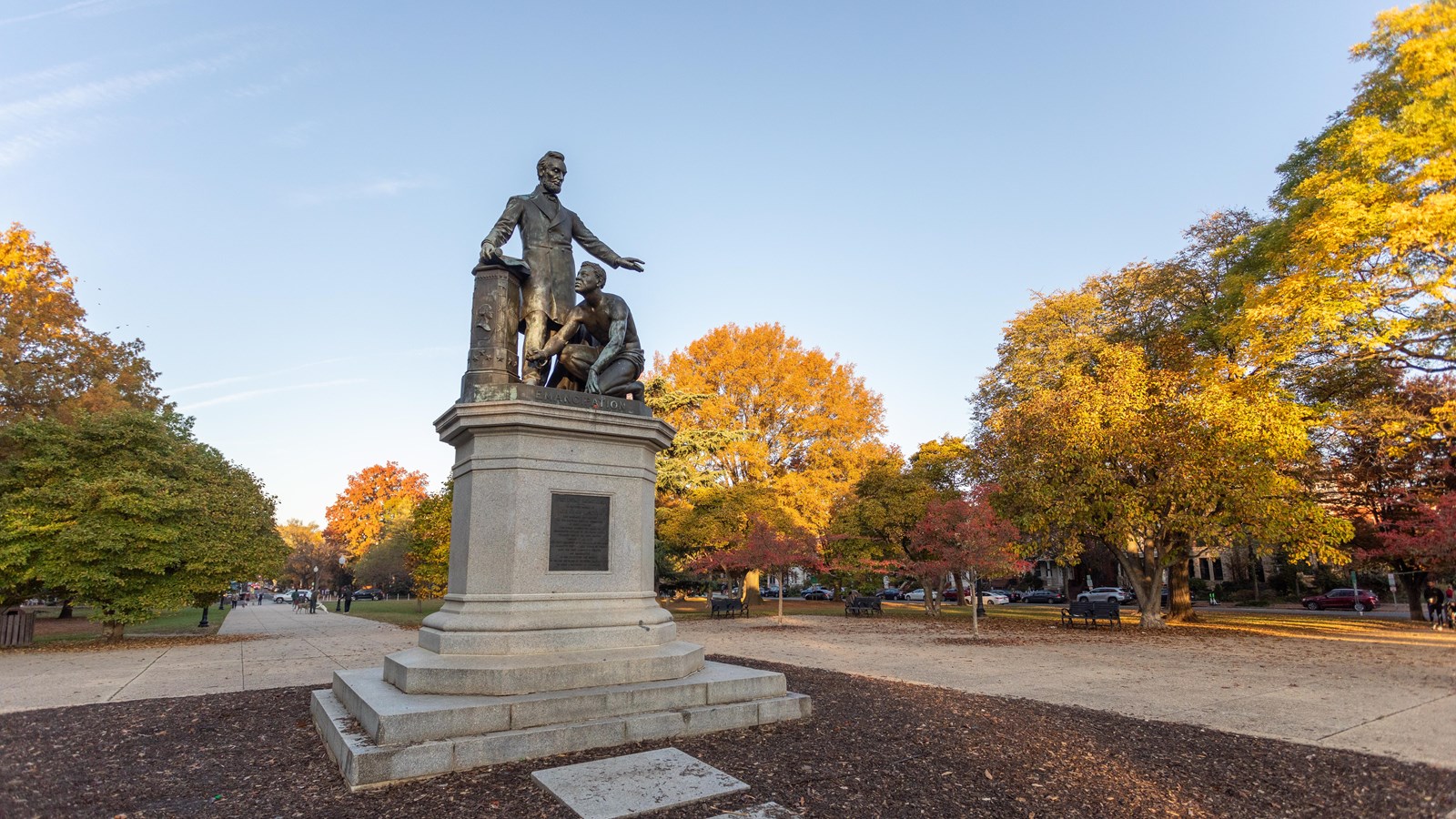
A bronze monument in Lincoln Park depicting Abraham Lincoln and a freed man, funded by formerly enslaved people and veterans of the United States Colored Troops.
Where is the Emancipation Memorial located?
The Emancipation Memorial is located in Lincoln Park on Capitol Hill in Washington, D.C., specifically at the junction of 11th Street NE/SE and East Capitol Street NE/SE.
What is the memorial known for?
The bronze statue depicts Abraham Lincoln holding the Emancipation Proclamation and extending a hand over a kneeling African American man, modeled after Archer Alexander, who is shown rising with broken shackles on his wrists.
Who funded the construction of the statue?
The memorial was funded almost entirely by donations from African Americans, including formerly enslaved people and veterans of the United States Colored Troops. Charlotte Scott kick-started the campaign with a five-dollar donation of her first earnings in freedom.
What are the visiting hours?
The memorial is located in Lincoln Park, which is managed by the National Park Service and is open daily.
What is the history of the monument's dedication?
Designed by sculptor Thomas Ball, the statue was dedicated on April 14, 1876, the 11th anniversary of Lincoln's death. The event was attended by President Ulysses S. Grant and over 25,000 people, with Frederick Douglass delivering the keynote address.
What should I check before going?
Use Gyde for context, then check official sources for current hours, tickets, construction, and closures.
What to know
The Emancipation Memorial, also known as the Freedman's Memorial or the Emancipation Group, stands in Lincoln Park on Capitol Hill. Designed and sculpted by Thomas Ball, the bronze monument was dedicated on April 14, 1876, the 11th anniversary of President Abraham Lincoln's death. The sculpture depicts a life-size Lincoln holding a copy of the Emancipation Proclamation while extending a hand over a kneeling African American man, who is shown rising with broken shackles on his wrists. What makes this memorial unique is its funding. The monument was built almost entirely with funds donated by African Americans, including veterans of the United States Colored Troops and formerly enslaved people. The campaign began in 1865 when Charlotte Scott, a former Virginia slave, donated five dollars—the first money she had earned in freedom—to start the fund. In total, freed slaves raised approximately $17,000 to $18,000 for the statue, while Congress later appropriated $3,000 for the stone pedestal. The figure of the freed man was modeled after Archer Alexander, the last Missouri enslaved man captured under the Fugitive Slave Law. For decades, this site served as the primary national memorial to Lincoln until the larger Lincoln Memorial was dedicated in 1922. The statue's orientation has also changed; it originally faced west toward the U.S. Capitol but was rotated east in 1974 to face the Mary McLeod Bethune Memorial. In recent years, the memorial has become a subject of intense debate. Critics argue the depiction is paternalistic and fails to honor the active role Black people played in their own liberation. This controversy led Congresswoman Eleanor Holmes Norton to reintroduce legislation in February 2021 to move the statue to a museum, reflecting the evolving interpretation of this National Register of Historic Places site.
Visitor tips
- The memorial is located in Lincoln Park, which is managed by the National Park Service and open daily.
- Look for the Mary McLeod Bethune Memorial nearby, as the statue was rotated in 1974 to face it.
- Wear comfortable walking shoes as the site is located at the junction of 11th Street and East Capitol Street.
Nearby context
Situated in the heart of Capitol Hill, the memorial is located in Lincoln Park at the junction of 11th Street NE/SE and East Capitol Street NE/SE. This neighborhood blends residential charm with the political weight of the nearby U.S. Capitol.
Sources
Evidence and links
-
150th Anniversary of the Emancipation Memorial
Lincoln Park is located at the junction of 11th Street NE/SE and East Capitol Street NE/SE in the Capitol Hill neighborhood in Washington,…
nps.gov -
Emancipation Memorial (Freedman's Memorial) - Washington DC
Located in Lincoln Park on Capitol Hill, the Emancipation Memorial (sometimes referred to as the Freedman's Memorial) features President Ab…
washington.org -
Emancipation Memorial (U.S. National Park Service)
Location: Washington, DC
nps.gov -
Emancipation Memorial in Washington, D.C. - DocsTeach
The **Emancipation Memorial**, also known as the **Freedman's Memorial**, or the **Emancipation Group** was created by sculptor Thomas Ball.
docsteach.org -
Emancipation Memorial
The **Emancipation Memorial**, also known as the **Freedman's Memorial** or the **Emancipation Group** is a monument in Lincoln Park in the…
en.wikipedia.org -
Emancipation Memorial Debate - World Press Photo
Critics argue that the statue is paternalistic, demeaning in its depiction of Black Americans, and that it doesn’t do justice to the role t…
worldpressphoto.org