
Washington, D.C., District of Columbia / Public art
Japanese Pagoda
A 17th-century granite sculpture gifted by the Mayor of Yokohama, this serene pagoda stands as a symbol of international friendship along the scenic banks of the Tidal Basin.
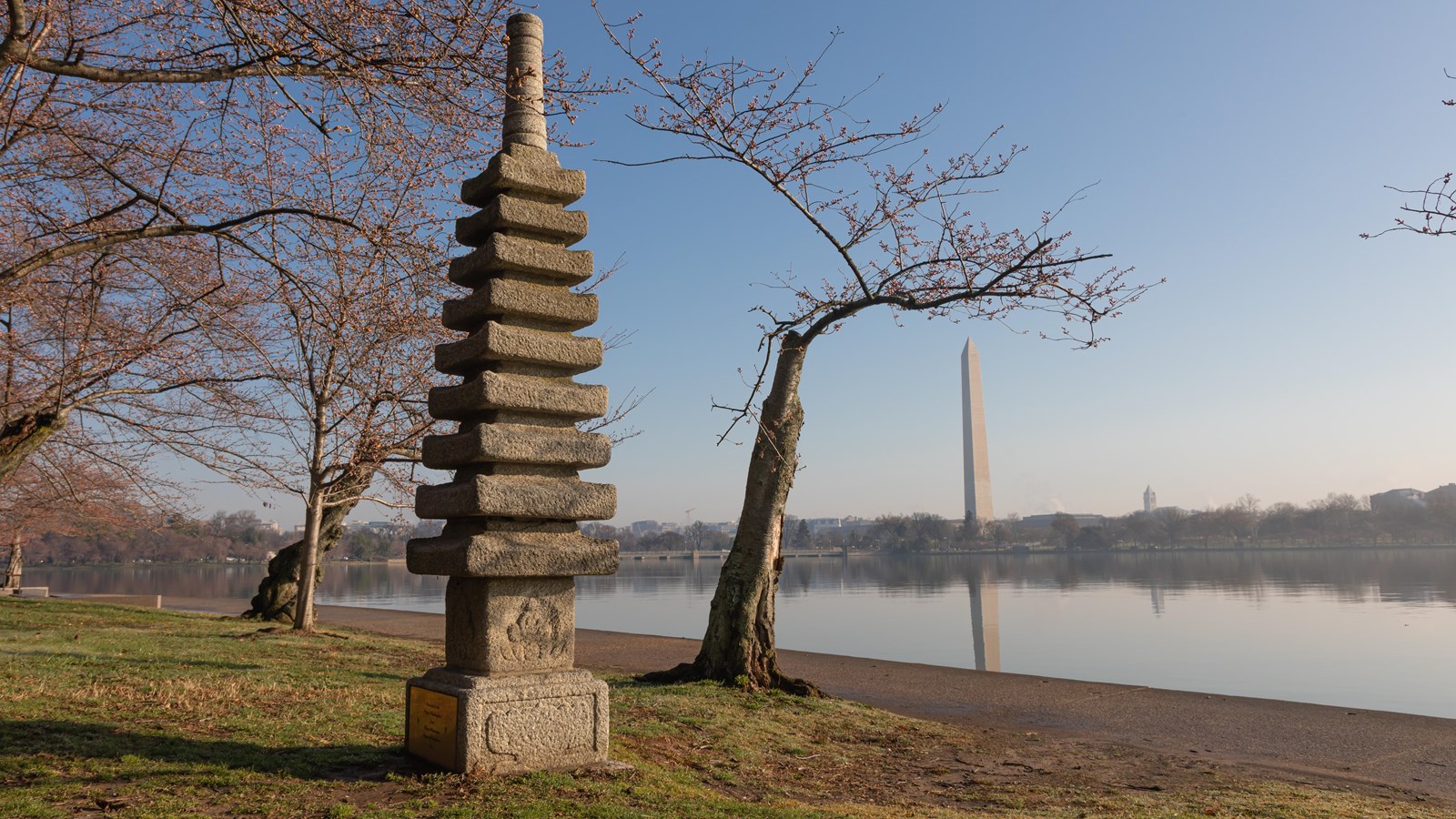
What is the Japanese Pagoda known for?
The Japanese Pagoda is a 17th-century solid granite sculpture that serves as a symbol of international friendship and cultural exchange between the United States and Japan.
Where is it located?
It is located in West Potomac Park along the southwest bank of the Tidal Basin, near the Franklin Delano Roosevelt Memorial and surrounded by cherry trees.
What is the history of the pagoda?
The pagoda was a gift from Mayor Ryoza Hiranuma of Yokohama, Japan, in 1957 to commemorate over 100 years of friendship and the 1854 Treaty of Peace, Amity, and Commerce. It was dedicated on April 18, 1958.
What does the structure look like?
The sculpture weighs roughly 3,800 pounds and consists of nine graduated square granite slabs topped by a ribbed cylindrical finial. The base features images of a Buddha seated on a lotus flower on each side.
Are there any interesting facts about its assembly?
The pagoda arrived from Japan in 1958 in five separate shipping crates without assembly instructions, resembling a stone puzzle. It was eventually assembled by specialists from the Smithsonian Institution.
What should I check before going?
Use Gyde for context, then check official sources for current hours, tickets, construction, and closures.
What to know
The Japanese Pagoda is a poignant expression of cultural exchange located in West Potomac Park. Carved from solid granite, this 17th-century sculpture weighs approximately 3,800 pounds. Its architectural form consists of nine graduated square slabs stacked from largest at the base to smallest at the top, all capped by a ribbed cylindrical finial. The base of the structure is particularly detailed, featuring images of a Buddha seated on a lotus flower on each side. This landmark was presented to the people of Washington, D.C., in 1957 by Mayor Ryozo Hiranuma of Yokohama, Japan. It was dedicated on April 18, 1958, to commemorate the centennial of peaceful relations established by the 1854 Treaty of Peace, Amity, and Commerce. A brass plaque set into the base further dedicates the monument to the spirit of friendship between the United States and Japan. Beyond its diplomatic significance, the pagoda embodies traditional Japanese ideology, representing the elements of sky, wind, fire, water, and earth from top to bottom. It is situated on the southwest bank of the Tidal Basin, placed near the fourth room of the Franklin Delano Roosevelt Memorial. The monument's arrival in 1958 was marked by a curious challenge. The sculpture arrived in five separate shipping crates without any assembly instructions, appearing to the recipients as a complex stone puzzle. It eventually required the expertise of specialists from the Smithsonian Institution to be correctly assembled.
Visitor tips
- Visit during the spring to see the pagoda surrounded by the iconic cherry trees originally gifted by Japan in 1912.
- Look closely at the base of the sculpture to find the carved images of the Buddha on lotus flowers.
- Allow extra time to walk the Tidal Basin loop, as this stop is located near the Franklin Delano Roosevelt Memorial.
Nearby context
The pagoda is tucked along the southwest bank of the Tidal Basin in West Potomac Park. It sits in a serene environment shared with the Franklin Delano Roosevelt Memorial and the famous cherry blossom trees that line the water's edge.
Sources
Evidence and links
-
Japanese Pagoda (U.S. National Park Service)
The Japanese Pagoda tucked along the Tidal Basin near the Franklin Delanor Roosevelt Memorial may not have the height or grandeur of the ci…
nps.gov -
Some Assembly Required, or The Oldest Puzzle in the Park
In 1958, a gift of friendship was delivered in five shipping crates. It appeared to be a complex stone puzzle, because it came without asse…
nps.gov -
History of the Cherry Trees Planted in Washington D.C.
April 18, 1958: The Japanese Pagoda, hewn out of rough stone, was placed on the southwest bank of the Tidal Basin and dedicated.
landscapeplants.oregonstate.edu -
Japanese Pagoda, Washington DC, Tidal Basin | Japanese-City.com
The pagoda is placed along the Tidal Basin as a gift of friendship from Japan to the U.S. ... April 18, 1958
japanese-city.com -
The Japanese Pagoda - Washington, DC - DC Design Tours
Like the trees, this landmark along the Tidal Basin was a gift from Japan. It was given to the United States in 1957 by Mayor Ryoza Hiranum…
dcdesigntours.com