
Washington, D.C., District of Columbia / Landmarks
Tidal Basin
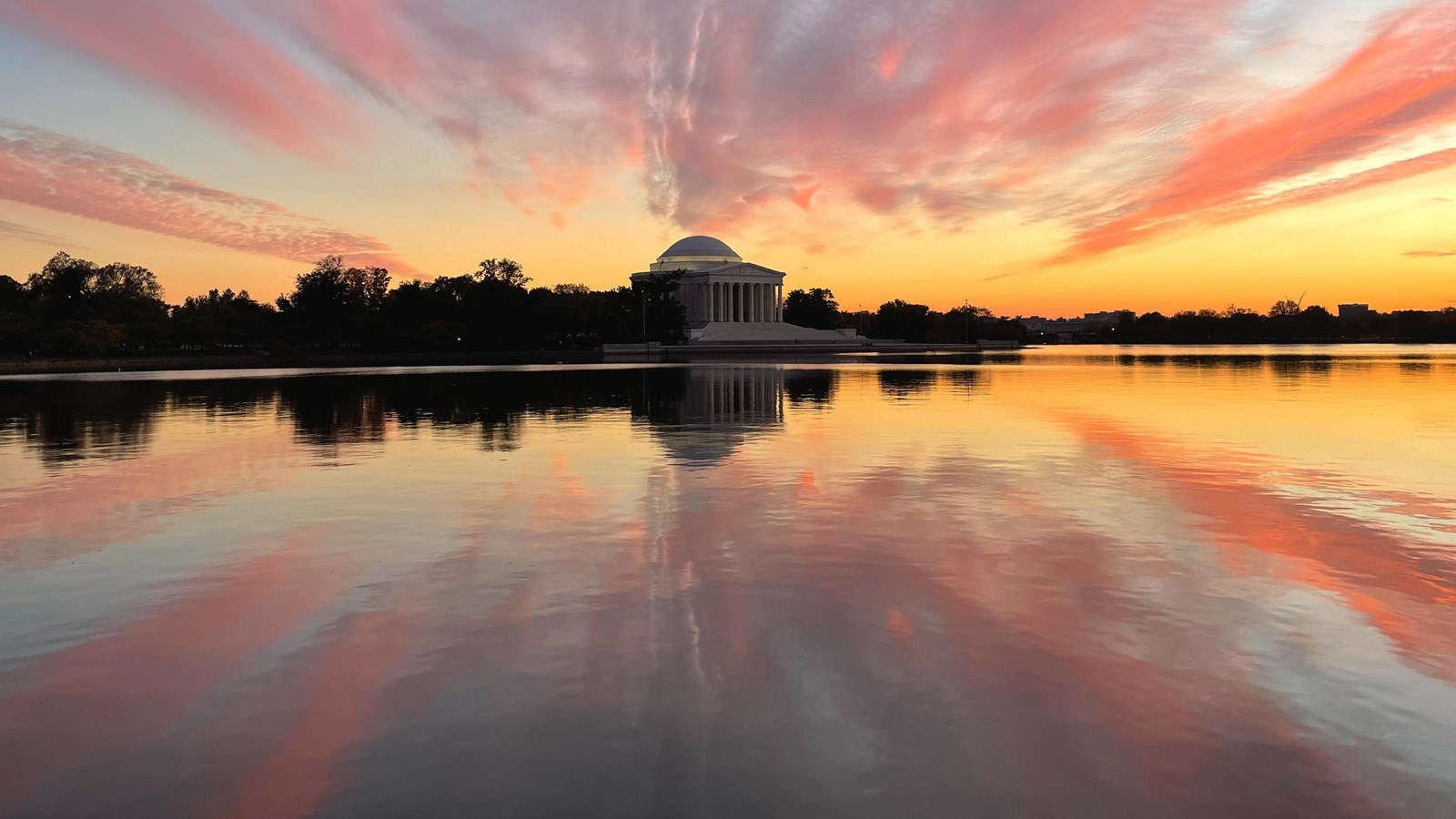
A quatrefoil-shaped man-made reservoir in West Potomac Park, the Tidal Basin is a scenic hub for national memorials and the world-famous National Cherry Blossom Festival.
What is the Tidal Basin known for?
The Tidal Basin is a man-made reservoir in Washington, D.C., best known as the focal point of the National Cherry Blossom Festival held each spring.
Which memorials are located around the Tidal Basin?
The basin is overlooked by the Jefferson, Martin Luther King Jr., and Franklin Delano Roosevelt Memorials. Other surrounding features include the George Mason and John Paul Jones Memorials.
Where did the cherry trees come from?
The cherry trees were a gift of friendship from the Japanese government to the United States in 1912.
Why was the Tidal Basin originally built?
It was conceived in the late 19th century to address sanitation and persistent flooding problems along the Potomac Flats, using tidal action to flush the Washington Channel and improve water quality.
How can I visit the different memorials around the basin?
The various national memorials surrounding the Tidal Basin can all be reached via the Tidal Basin Loop Trail.
What should I check before going?
Use Gyde for context, then check official sources for current hours, tickets, construction, and closures.
What to know
The Tidal Basin is a man-made reservoir situated between the Potomac River and the Washington Channel in Washington, D.C. [328c7fdf-5fc3-4b60-88af-5c1a3b587678]. Originally called Twining Lake, this 107-acre body of water was constructed by the U.S. Army Corps of Engineers between 1882 and 1897 [3c6abc23-e30c-4b5c-bd38-7a62e7d9aa9c]. It was conceived in the late 19th century to solve persistent sanitation problems and flooding along the Potomac Flats [990652d5-3e02-4573-a51e-bafffba2260f]. Designed with a quatrefoil shape, the basin functions as a hydraulic tool to improve water quality. Twice a day at high tide, approximately 250 million U.S. gallons of water from the Potomac River enter the basin through inlet gates to flush the Washington Channel [4855a398-8fb8-4b29-9504-78ce885c79a1, 3c6abc23-e30c-4b5c-bd38-7a62e7d9aa9c]. While it began as a utilitarian project, it has evolved into an iconic public landscape for recreation and remembrance [990652d5-3e02-4573-a51e-bafffba2260f, 962747f5-4ceb-4d43-b957-e74c5ca78fea]. The basin is most famous for its cherry trees, which originated as a gift of friendship from Japan in 1912 [f892022a-3f15-4ee6-81c4-30e8dbaab15e]. On March 27, 1912, First Lady Helen Herron Taft and Viscountess Iwa Chinda planted the first two trees on the northern bank [f892022a-3f15-4ee6-81c4-30e8dbaab15e]. Today, over 3,800 cherry trees line the area, serving as the focal point for the annual National Cherry Blossom Festival [5da503f6-9c69-4e44-9f7b-34b59ba9ee6d, 328c7fdf-5fc3-4b60-88af-5c1a3b587678]. Surrounding the water are several major monuments reachable via the Tidal Basin Loop Trail [5da503f6-9c69-4e44-9f7b-34b59ba9ee6d]. The Jefferson Memorial, Martin Luther King Jr. Memorial, and Franklin Delano Roosevelt Memorial all overlook the basin [328c7fdf-5fc3-4b60-88af-5c1a3b587678]. Recent restoration work supported by the Great American Outdoors Act has added new cherry tree plantings and upgraded infrastructure to protect these park resources [4162d599-bd8b-4582-80ec-2e750e46657f].
Visitor tips
- Walk the Tidal Basin Loop Trail to visit multiple memorials in one continuous journey.
- Visit during the spring to experience the National Cherry Blossom Festival.
- Wear comfortable walking shoes as the loop covers a significant distance around the 107-acre basin.
Nearby context
Located within West Potomac Park, the Tidal Basin sits just south of the Washington Monument and serves as a scenic transition between the National Mall and the Potomac River waterfront.
Sources
Evidence and links
-
Cherry Trees & Tidal Basin - Video (U.S. National Park Service)
Recent restoration work has improved conditions across the Tidal Basin and National Mall, including new cherry tree plantings and upgraded…
nps.gov -
Tidal Basin (U.S. National Park Service)
The Tidal Basin was conceived in the late 19th century as a solution to persistent flooding and sanitation problems along the Potomac Flats.
nps.gov -
National Mall Tidal Basin
The National Mall Tidal Basin, an urban National Park and part of America's front yard, is a beloved and iconic public landscape.
savingplaces.org -
Tidal Basin - Wikipedia
The Tidal Basin is a man-made reservoir located between the Potomac River and the Washington Channel in Washington, D.C.
en.wikipedia.org -
Tidal Basin | TCLF - The Cultural Landscape Foundation
The quatrefoil-shaped Tidal Basin stores some 250 million gallons of water daily between the Potomac River and the Washington Channel.
tclf.org -
Unlocking Place-based Meanings through Inquiry at the Tidal Basin
The Tidal Basin had been completed in 1896, mainly as a tool for using the tidal power of the Potomac River to flush the Washington Channel…
openrivers.lib.umn.edu